Showing posts with label Appliance Channel. Show all posts

Thursday, June 4, 2020

Samsung Plasma TV Rescue - PART 1 to 4

I found an abandoned Samsung Plasma TV PS-42S5H on the roadside, and decided to see if I could rescue it. 

The TV was in a completely unknown state, along with its remote control, so I had to do a complete troubleshooting cycle on the TV and its remote.  

Watch as I systematically move through the stages of troubleshooting towards an (ultimately) successful resolution.

Part 1


Part 2


Part 3


Part 4


Saturday, May 16, 2020

LG 4K TV - Power & Wall Mount Installation (PART 1 to 6)

This video series documents how I installed my newly repaired 49" 4K TV (LG49UH6500) on a wall where there was no power available.  I did so by branching into the dedicated air-conditioning circuit, installing a plug where there was formerly a switch, and putting a plug on what was formerly a hard-wired connection.  In the end, I overcame all of the many challenges, large and small, that presented themselves and was able to install the TV and enjoy everything it offers.


Part 1


Part 2


Part 3


Part 4


Part 5


Part 6


Wednesday, May 13, 2020

Ariston FBG IX Oven Element Replacement

Our Ariston FBG IX Oven was tripping the main breaker whenever we tried to use the electric grill, so we replaced the element.  Here's how - and where to get the part...

https://amzn.to/2zvPyvr


Tuesday, May 12, 2020

Candy Range Hood LED Ugrade!


Bamboo House is a very strange place.  There were all kinds of inexplicable problems when we moved in, especially with respect to the appliances in the kitchen.  

For example the Range Hood, which is a high-quality brand (CANDY), had been installed, but the user manual had never been taken out of the assembly!  Who knows how many years of service the fan underwent with a massive air blockage, but it was significant.  The manual(s) were wrapped in plastic, which was covered in stale cooking oil.  Once we removed the plastic covers, the manuals were in perfect condition.  WEIRD.

The other thing that seemed strange was the light.  It was yellow and very weak.  I mean *really* weak.  So, once I had figured out how to open and service the filters (which had never, ever been cleaned and which required a steel brush and turpentine to get even close to clean), the next step was to understand why the light was so dim.

As it turned out,. the light was dim because there was an ancient light bulb in there, and the frosted glass cover was coated with old, stale cooking oil!  Once again, I had to break out the steel brush and turpentine, as well as steel wool!

Even stranger, the CANDY Range Hood was configured to take TWO light bulbs, even though it only had one installed.  So I ordered a couple of replacement LED bulbs (9W) and this video shows what happens when you put pair of high-intensity white bulbs in where a single low-intensity yellow filament bulb had been before...


Sunday, April 12, 2020

Bamboo House - Induction Cooktop UPGRADE (Part 1 to 8)

One of the things that Mrs. Maker demands is a kitchen that affords her with the appropriate stage upon which to develop her culinary delights. 

One of the major drawbacks of Bamboo House was its kitchen, which I have worked on steadily over the past few months, adding features and capabilities as I go. 

This video series documents how I upgraded the induction cooktop from a half sized, 2-ring model (that was broken) to a full sized, 3-ring model.

Part 1


Part 2


Part 3


Part 4


Part 5

Part 6


Part 7


Part 8

Thursday, April 2, 2020

Quick Fix: 4K LG TV w/ Flickering Screen Problem

A bit bored and looking for a challenge, I decided to buy a "broken" LG 49UH6500 4K TV to see if I could fix it.  

I already have a bunch of TV's, of course...but all of them are stuck in a place that I cannot currently access due to the lockdown in Hong Kong and the fact that my work is closed from public access.  Also, I don't have a 4K TV and I was curious to see if the image quality was any different than the many 2K TVs already in my possession (1920 x 1080 is 2K).

A bit of searching the local 2nd hand websites uncovered a likely candidate - a 3-year old LG 49-inch television that went bad about a month after the warranty period had expired (bad luck, that).  The TV displayed a very unique and peculiar behaviour, with the screen stable for three seconds, then unstable for three seconds, then stable again (and so on).  

The owner wanted about USD50.00 for it, so I took the plunge and bought it, reasoning that I could at least squeeze a disassembly video out of it, if not a repair one.  

I also assumed that the LG would be configured like most modern LCD TVs, with three boards:  (a) A power board; (B) A motherboard; and (C) A logic (or controller board).  Well, you know what assume can make of someone.   It certainly happened to me.  You can only imagine my dismay when I found out that LG has integrated their controller board with the physical panel, making the replacement (or repair) of that part a very complicated and expensive affair.

Luckily, I came across a video from (Indonesia?) where a technician had figured out a way to hack the LG 4K TV "shared bus" design.  He had determined that certain traces in the machine had been duplicated across connectors, and found out that blocking (or "masking") off one of the duplications resulted in a stable picture.

Inspired by that video, I replicated the method he explained (in Bahasa) and have produced my own video of how to repair the LG 4K Flickering Picture problem, in English, with great success!


Friday, March 27, 2020

WINO the UNCOOL Wine Cooler (Part 1 to 6)

Some people leaving Hong Kong asked if anyone was interested in "rescuing" a broken wine cooler - how could I resist? WINO is an 18-bottle capacity Vinvautz wine cooler manufactured (of course) in China to the most widely applicable specifications possible. It's actually not a "Vinvautz". The unit is apparently a white label wine cooler that carries a number of badges (given they all share the same controller board). This includes Emerson, Midea and some other mid-tier brands that tend to purchase appliances that have reached commodity status.


Part 1

Part 2


Part 3

Part 4


Part 5


Part 6


Monday, March 23, 2020

Fixing WINO - The UNCOOL Wine Cooler!


The Story Of The Wine Cooler That Didn't Cool


Failing capacitors are often at the heart of power supply failure, so that should be the first components to look at when a device stops working properly.  In my case, the failing device was WINO - a Vinvautz 18 Bottle Wine Cooler.  It apparently stopped working one day, and the original owners just didn't have the time or opportunity to go about fixing it.


When I picked WINO up, it was already disassembled.  The power/logic board had already been removed.


The replacement filtering capacitors weren't expensive at RMB1.50 each, so I got ones that were rated for the same heat environment (CD288H  @ 105C) and a higher voltage (400v).  In total, five replacement capacitors cost about USD1.00.


The capacitor replacement, while probably a good idea, didn't solve the problem, so I needed to go downstream from there.


Looking at the board


This particular one looked like it had been serviced somehow:


The next component to take a look at is the STPS2045CTC, which is a pair of Shottky diodes in a TO-220 style transistor package


Dual center tap Schottky rectifier suited for SwitchMode Power Supply and high frequency to DC converters. Packaged either in TO-220AB, I²PAK, or D2PAK, this device is especially intended for use in low voltage, high frequency inverters, free wheeling and polarity protection applications.

Looking on the other side of the board, I discovered that it was a Schottky diode pair (STPS2045CTCin a TO-200 transistor package


Converting from AC to DC is simple when using a Schottky diode STPS2045CT rectifier from STMicroelectronics. Its peak non-repetitive surge current is 180 A, while its maximum continuous forward current is 20 A. It is made in a dual common cathode configuration. This rectifier has an operating temperature range of -65 °C to 175 °C.


Here's what a common cathode configuration looks like, electronically speaking:


UPDATE:


After replacing the STPS2045CTC with a replacement unit, the problem persisted.  If the machine has been turned off for a long time, you get a buzzing sound and the LED lights flicker.  Turn the machine off and then back on again, and you get nothing - dead machine - unless you wait a while.

Strangely, the machine boots when the high-current connector to the cooling system is unplugged, indicating a problem of some kind with that system along - by that I mean that the interface boots and the fans activate.  


Even stranger than that, if you turn the machine on with the pelletier circuit disconnected, then connect it after the machine is up and running, the machine works fine!

- Replace Power/Logic Board = RMB150 / USD20.00


- Introduce 12v Timer Delay Board = RMB16 / USD2.00

Which is cheaper and more fun?  Why the 12v Delay Timer Board of course!


ENTER The 12v Delay Timer Board


Another way to get WINO working is to simply work around its power supply problem with a timer delay board that defers the activation of the pelletier cooling circuit until all of the other systems are in place.

(similar to stereo delay timers)

Here's the board I decided to use:


Here's how you wire it in:


REFERENCES

https://www.youtube.com/watch?v=KBhVS7GhCOM


Wednesday, December 25, 2019

XMAS Dripping Aircon Water Bottle Hack!

There's nothing worse than an air conditioner that's dripping on people carrying presents and items of good cheer in the streets of the village below you on Christmas Day! 

So I took it upon myself to not be in the aspect of the Grinch and pay attention to the offending unit by addressing its inability to drain, and thereby in its operations, offend and outrage the body public . 

Heaven knows, if there's any day of the year to not be a drip, it's Christmas Day!  Luckily, due to the fierce heat of December, we had many empty water bottles around the house. 

Fortuitously one of them named VITA, or LIFE in the language of the Romans - ancient occupiers and chroniclers of the peoples of Judea, the area from which the story of the Carpenter Hero of Matthew and Luke spring, that being, of course, at the center of our Christmas touchstone, was available to be pressed into service as a kind of air conditioner sangreal to catch the issue that sprang, unbidden, unwanted and unexpected from this, our most holey of air conditioners.

Come all ye faithful, joyful and triumphant!  Watch this story unfold before your very eyes, and be amazed!


Monday, December 23, 2019

How To Spruce Up A 2nd Hand Dehumidifier Using BRASSO & VELCRO

Mrs. Maker wants a second dehumidifier - so why not a 2nd hand second dehumidifier says Mr. Maker? OK, says she, as long as it looks and works like new. Well, your wish is my command, says Mr. Maker - and makes it so!We bought this humidifier for about USD35 and it was in good operating condition, but slightly beat up physical shape. A little elbow grease, some BRASSO and two small pieces of VELCRO later, all was right again. Help support Mr. Maker by buying some BRASSO! https://amzn.to/2Px5WQP Now, the unit looks brand new, the power cord is no long dragging everywhere! All is right and Mr. Maker has saved a little money so he can go out and buy more tools - or nifty little things to make Mrs. Maker even happier. Either option seems great!


Friday, May 10, 2013

Dualit 889 Overhaul


I just love my Dualit 889 espresso machine.  


I like the way it looks.  I like the coffee it makes.

But, comparatively speaking, it needs a lot of TLC to stay in operations.  

Over the years I've had to re-build it a couple of times.

- The bottom seal on the boiler baked away to nothing, causing a huge leak
- The mode selector rocker switch broke, forcing me to glue it.
- The power switch broke, forcing me to hard wire it

Now, some old problems have re-surfaced and some new ones have been accumulating, so today I decided to see what I could do about fixing them.

1)  It has developed a leak (again!)
2)  The selector rocker switch has broken (again!)
3)  The power LED no longer turns on for some reason (this is new)


Suspicions:


The Leak:

I'm thinking that this is probably another seal gone bad.

The Broken Rocker Switch:
This has been a low-level, nagging issue for a really long time with this unit.  It's broken before and I tried to use CRAZY GLUE to fix it.  Didn't last long.  

But, because it's only half-broken (and I'm lazy, and it's non-critical) it's been in this state for a long, long time.  Like months.  Actually, it's kind of useful in a weird way because it allows me to have a greater degree of control that when it is working "normally".  That's probably a rationalization :)

The Failed Power LED Indicator:
The LED used to work (a nice RED color) whenever the machine was on.
Then it became a flickering LED, then it went out - never to return.
The HEATING light (YELLOW) is still working fine.


The Rebuild:

Ok, let's get started with the rebuild...


The Dualit 889 requires a T10 and a T15 screwdriver set to be opened up.

Here you can see them lined up nicely in front of the machine.


The faceplate is held in place by four screws, one at each corner.  

It's decorative and easy to remove.  
I just took mine off and put it to the left.  
You can just see it in the corner of this picture.

Please note that the nuts the screws turn into are loosely held in these special slots built into the case, so be careful to make sure you collect them too, not just the screws.  If the nuts (they are square) fall out and roll under something they can be a pain to retrieve.


The next pair of screws to remove is about mid-way down the face, one on each side.


The next pair of screws to remove are a bit tougher to locate.

Flip open the back lid
Remove the water reservoir
The pair of securing screws will be revealed (and accessible)
They also need to be unscrewed.


Eight (8) screws later - Voila!  The machine cracks open.  

Two sets of wires connect the top of the machine to the body.  
One set of wires is for POWER and PUMP wiring
One set of wires is for the POWER and HEATING indicator lights


Here's the INDICATORS wiring

My that looks wet!  
No wonder the power light isn't working now.
Black, Red and Blue - hmmmm


Here's the "hot end" of the espresso machine.  

(Hahaha!  I've been working on RepRap printers for too long!)

There's a 3-way (mechanical) housing below that white clip-on assembly.
The tubes entering the 3-way housing are made of heat resistant material.
I think I remember that they are made of TEFLON.


A video of the action...


Steam is not supposed to emerge from within the machine...


This much steam is BAD for the internals of the machine.

Like the power indicator light...


Still, it makes a decent cup of coffee!  

<slurp>....ahhh..... 


Broken 3-way rocker switch.  

This thing is really fragile.  Third repair now.
This time I'm going to go ALL THE WAY with fixing it.


The POWER switch broke into two pieces about a year ago.

So I snipped off one of the blades from the back of the switch , so I just hardwired the unit to the on position by putting a common blade between the leads.  While I have the machine open, I think I'll change out the transparent tape for some PVC tape.   Safer and looks more pro...


Another view of the top of the machine...


One more...


Top view of the switch mounted to the white housing that clips to the 3-way.

How about we remove the screws around it and see what what we can see?


Screws out...


Alright, let's try to get this thing off the boiler without breaking anything...


3-way removed.  

The big silver thing is the top of the boiler.
Hmm...the top of this boiler has TWO interesting characteristics:

- There's a discoloration that clearly indicates there is a leak here

- The exit point of the boiler (where the O-RING goes) is full of SCALE

Before I put this unit back together that scale needs to be removed.


Here's the bottom of the 3-way.  

Note the RED silicone O-RING.  One of those also fits into the top.
These things COOK over time, especially if they are in physical contact with the boiler.
The boiler gets HOT, as in over 100 degrees Celsius hot.  Droplets dancing on it hot.


Getting rid of the scale by soaking the top of the boiler in vinegar (apple cider vinegar, don't have white!).  Using Q-TIPS because that's what came to mind...


Soaking, soaking, soaking...


Maybe if I add more vinegar this will go faster?


Another view of the bottom of the 3-way switch


Doesn't hurt to coat everything made of rubber in this machine in silicone grease, which will lubricate, protect and (somewhat) restore old, tired rubber back to its originally springy self...


OK, Q-Tips are really not effective enough.  

Let's try SOAKING a piece of paper towel in vinegar and jamming it into the hole...


While waiting for vinegar to do its thing, how about working on the rocker switch?


File stem of rocker switch with old, gnarly nail file. 


File body of rocker switch with with gnarly nail file...


The exit point of the boiler.

Now nice and clean after some soaking and scraping with a sharp object....


There's a cotter pin holding the tube from the 3-Way to the group head.

An O-RING seals the connection.
While it feels loose to me, they don't leak.  So...OK...


OK, everything coated with silicone grease and re-assembled, ready to go into service...


I even greased the travel of the switch.

Now it just *glides*...


Houston, we *still* have a problem...

Crap!  What could be wrong?


Look again...


Wow!  A CRACK! 

Running almost the entire length of the unit!
I'll be darned!


At first I thought that this was just a seal issue, like what I had a long time ago with the bottom of the boiler.  NOPE.  Now, after fiddling with changing seals all afternoon, I see that the valve body (which is made of brittle, high temperature plastic) has cracked.  


OK, Not surprising after 12 years of being in service, just a pain.  


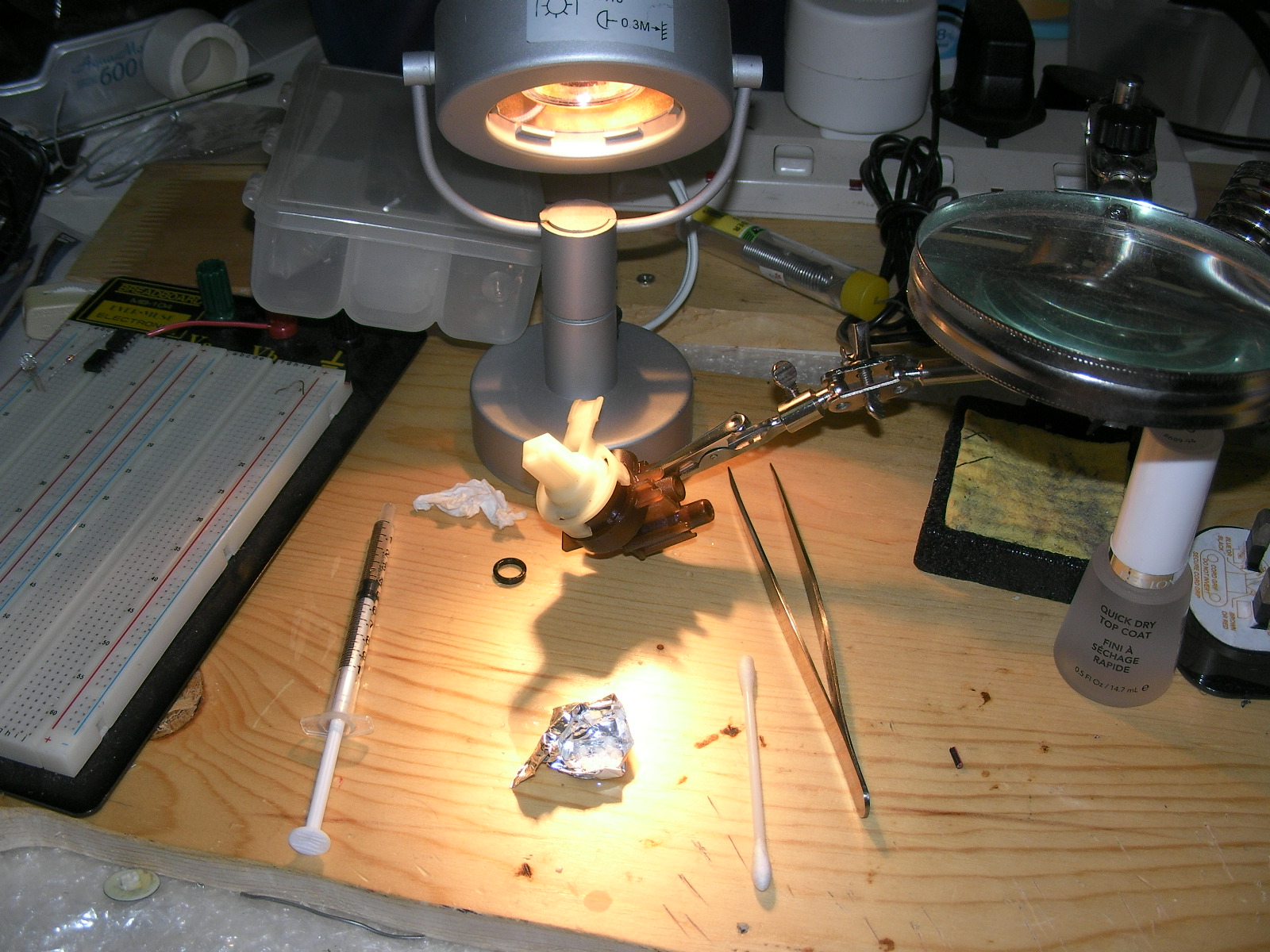
Time to get out the chemistry set.

First, soak valve body crack with acetone to soften it up.  About a 5 minute soak
Next, soak 3mm ABS beads cut from a 3D printer filament in acetone for about 5 minutes...


Assembling the instruments for the surgical theatre....


OK, the beads  are *soft* now, time to start stuffing the assembly...


Stuffing, stuffing, stuffing...


More stuffing....


OK, now for the nail polish.

Gosh I hope its not too toxic....


More filament, this time a contiguous chunk to give the patch structural stability and hopefully some additional resistance to the 15BAR pressure this assembly experiences.  

Cover with LOTS more nail polish...


Put second filament in place to give the first filament a buttress.

Load up with nail polish to give everything something to bind to...


Everything is bubbling and melting....good!...


Use a drop of nail polish to secure the central spindle of the 3-way rocker switch in place...


Set up working area for hot glue 


Apply hot glue along perimeter of spindle. 

Hope like crazy it adheres enough to matter...


Here's the cooled down unit.  Blob-o-rama!


Here's a pic of the rocker switch Installed.

Boy I do hope I got the cogs registered right against each other...


Alright, everything seems to fit OK - even with all that extra glue loaded in there...


Another view of this crazy rocker switch...


The electronic INDICATOR panel is not OK.  

Before, when powered on, it used to light up (RED).
Now, when the boiler is heating up it still lights up (YELLOW).

But one day the RED power light flickered and eventually went out

Now it does not light at all.  It could have something to do with all that steam flying around...


The underside of the PCB.  
I have no idea what the lighting scheme of this board is.  
It looks like little rows of surface mount LED's

Hmmm...I just fiddled with these little light banks and now NEITHER light up.  :(


You know, that might just be the right excuse to put a PID on this machine  :)


But first, let's see if we can just get a couple of LED's to light up :)


The INDICATOR circuit in the Dualit is *very* reminiscent of a circuit described by William Liang at a recent HackJam ("Plugging LED's directly into a 220v Main without going POW!").


I wonder if I've just encountered Dr. Liang's circuit IN THE WILD.


Hahahaha!  They all said he was crazy!  This circuit is twelve years old already!


Well, maybe I'll just see what power is going through the unit and go from there...


Here's that clear tape situation all straightened away..


The bottom of the panel.  

There's really nothing special here.
Except for the fact, of course, that neither light works now!


Decided to give myself just a bit more compressive power by adding an extra very thin washer under the original..


PLENTY of silione grease to help the rocker switch rock.

It's only 99% straight, so theres a (tiny) point of rocking resistance...


Well, if the panel isn't working, why not try to figure out what the leads mean and replace it?


Here's the leads labeled.

Pretty simple stuff really.
There's one neutral (black w/ red stripe).
There's a live coming off of the boiler thermal switch.
There's a live coming off the power switch.

So what's the voltage here?  220vac?
Let's check...


OK, the voltage is 220vac

I happen to have some extra power bar indicator lamps hanging around.
How about testing to see if they'll make a quick & dirty set of POWER and BOILER lights?


Alright, we have very encouraging results here!
Next step is to see if the BOILER light goes out when the unit reaches operating temperature.
I can't do that until the plastic weld has completely cured, which will take at least 6 hours.

Goodnight.


Bad News - The Plastic Weld:

The plastic weld was a total, complete failure.  :(

When operating at temperature the entire assembly just gets yucky soft.  Like marshmallow.


Now, the unit leaks worse than it did before!  :(


BUT - I can still make coffee!  :)


The only downside at the moment is that the machine is now spitting water everywhere.  A *stream* of water is now issuing from the bottom of the machine and leaking all over the counter and the floor. 


Time to call in the Europeans!


http://www.juraprofi.de


Time to call in the Americans!


http://www.shop.partsguru.com


Let' see what kind of answers we're going to get from them over the next couple of days.


Until then, I'm going to work on the POWER and BOILER indicator lights and put the machine back together (over a bucket!) with a piece of sponge stuffed in the crack to prevent the spitting.


<pic>


Good News - The Rocker Switch Refurb:

The good news is that the rocker switch is working just fine :)

tbc....